Do you know how to deal with these problems in CNC machining?
CNC NC Programming Routine explain your question! More information about CNC machine or router control panel buttons & keys, please read: “what are the mean of CNC machine buttonS & keys?“
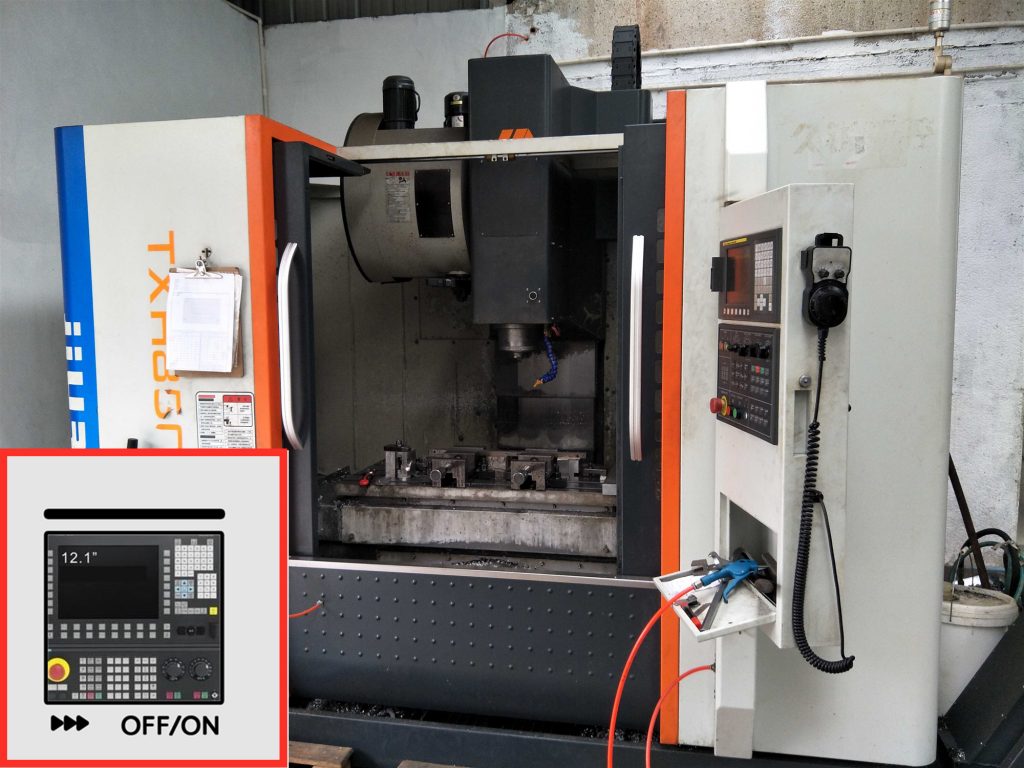
CNC NC Programming Routine, Normal Machining problems & Solution
OVERCUTTING OF MACHINING WORKPIECE:
OVER CUTTING REASON:
- Ballistic cutter, tool strength is not too long or too small, resulting in tool bouncing cutting tool.
- The operator operates improperly.
- Cutting allowance is not uniform. (e.g. 0.5 on the side and 0.15 on the bottom of the curved surface)
- Improper cutting parameters (such as too big tolerance, too fast SF setting, etc.).
IMPROVE METHODS:
- The principle of using knives/cutters: big or small, short or short.
- Add angle clearing procedures, and keep the margin as evenly as possible. (The side and bottom margins remain the same.)
- Reasonably adjust the cutting parameters and round the corner with large margin.
- Using SF function of machine tool, the operator can adjust the speed slightly to achieve the best effect of machine tool cutting.
CENTERING PROBLEMS ( TO FIND THE POSITION OF THE MACHINING WORKPIECE IN THE COORDINATE SYSTEM OF THE CNC MACHINE CENTER.
REASON ANALYSIS OF CENTERING PROBLEMS IN NC MACHINING PROCESS:
- Operator’s manual operation is inaccurate.
- There are burrs around the die.
- There is magnetism in the middle bar.
- The four sides of the die are not vertical.
IMPROVE CENTERING OPERATION:
- Manual operation should be carefully checked repeatedly, and the points should be as high as possible at the same point.
- Use oil stone or file to deburr the periphery of the die and wipe it clean with rags, and finally confirm it by hand.
- Demagnetize the middle bar before dividing the die. (Ceramic can be used to divide the middle bar or other parts.)
- Calibration check whether the four sides of the die are vertical. (Verticality error needs to be checked with fitter scheme.)
CUT TOOL SETTING PROBLEM:
REASON ANALYSIS OF CUTTING TOOL SETTING :
- Operator’s manual operation is inaccurate.
- Error in tool clamping.
- The blade on the flying knife is wrong (the flying knife itself has some errors).
- There are errors between R knife and flat bottom knife and flying knife.
IMPROVE METHODS OF CUTTER SETTING:
- Manual operation should be checked repeatedly and carefully, and the knife should be checked at the same point as possible.
- Clean the tool with air gun or rag when clamping.
- A blade can be used when measuring the tool rod and smooth bottom of the blade on the flying knife.
- The error between the flat and flying knives of R-knife can be avoided by setting up a tool-setting program separately.
MACHINE COLLISION – PROGRAMMING:
REASON OF MACHINE COLLISION:
- Insufficient or no safety height (knife or chuck hitting workpiece when fast feed G00).
- Writing errors of tool on program sheet and actual program tool.
- Writing errors in tool length (edge length) and actual depth of machining on program sheet.
- Writing errors of Z-axis number of depth and actual Z-axis number on program sheet.
- Error of coordinate setting in programming.
IMPROVE METHOD:
- Accurate measurement of workpiece height also ensures that the safety height is above the workpiece.
- The tool on the program sheet should be consistent with the actual program tool (try to use the automatic program sheet or the picture to produce the program sheet).
- Measure the actual depth of the workpiece. Write clearly the length of the tool and the length of the edge on the program sheet (the general tool clamp length is 2-3MM higher than the workpiece, and the length of the blade avoids void is 0.5-1.0MM).
- Take the actual Z-axis number on the workpiece and write it clearly on the program sheet. (This operation is usually written for manual operation to be checked repeatedly).
CUT TOOL COLLISION – OPERATOR:
REASON:
- Deep Z-axis tool alignment error.
- Errors in the number of collisions and operations (e.g. the number taken unilaterally has no radius of feed, etc.).
- Use wrong knife (e.g. D4 knife and D10 knife).
- Program error (e.g. A7.NC goes A9.NC).
- The handwheel is rocking in the wrong direction during manual operation.
- Manual fast feed in wrong direction (e.g. – X press + X).
IMPROVE:
- Deep Z-axis tool alignment must pay attention to the position of tool alignment. (Bottom, top, analysis, etc.).
- The number of collisions and operands in points should be checked repeatedly after they are completed.
- When clamping the tool, it should be checked repeatedly against the program sheet and program before loading.
- Procedures should go one by one in order.
- When using manual operation, the operator himself should strengthen the operation proficiency of the machine tool.
- When moving rapidly by hand, Z-axis can be raised to the workpiece and moved.
SURFACE ACCURACY:
REASON:
- The cutting parameters are unreasonable and the workpiece surface is rough.
- The cutting edge is not sharp.
- Tool clamping is too long and blade avoidance is too long.
- Scrap removal, air blowing, oil flushing is not good.
- Programming cutter-walking mode, (you can consider milling as far as possible).
- Workpiece has burrs.
IMPROVE:
- Cutting parameters, tolerances, allowances and speed feed should be set reasonably.
- Tools require operators to inspect and replace them irregularly.
- When clamping the tool, the operator is required to clamp it as short as possible and the blade avoidance is not too long.
- For flat knife, R knife and round nose knife, the setting of speed feed should be reasonable.
- Workpieces have burrs: the root of our machine tools, cutting tools, the way we move the knife has a direct relationship. So we need to understand the performance of machine tools and repair burred edges.
KYLT Precision CNC machining services (milling & turning service), Fast prototyping, Fixture/Jig/Tooling making,Aluminum die casting & plastic injection parts. Email:cnkylt@aliyun.com +008615195010186
KYLT CNC Machining Services:
KYLT CNC Precision Machined Parts:
More information about Machining Technology:
评论
发表评论